Ask which team owns digital PR in most marketing departments and you’ll get a confident answer, followed by a slightly nervous laugh. Nobody’s quite sure whose budget it sits in. SEO gets the technical fixes and the content calendar. PR gets the brand mentions and the trade press write up. Different teams, different agencies half the time, different slide in the quarterly review.
That split was already costing people opportunities. And in the AI era; it’s getting expensive.
What I changed, and what happened next
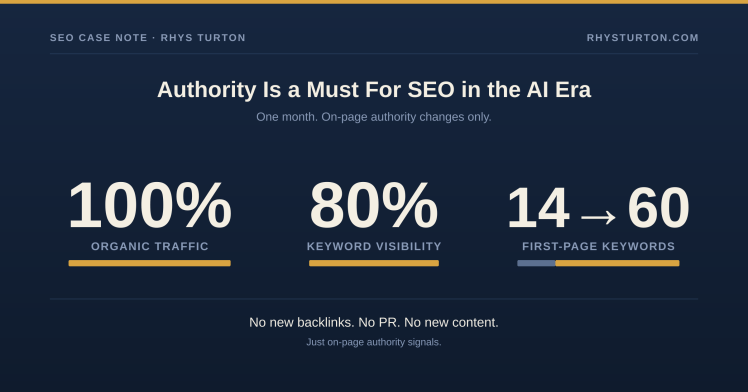
At a previous SaaS role, I ran a project that had nothing to do with PR, backlinks, or new content. I added around 30 pages to the site: individual author pages for everyone writing for us, an accreditations page, and a proper “why this brand” page that actually said something instead of repeating the homepage in different words. I also went back through every existing blog post and fixed the author schema, so each one was correctly and consistently attributed to a real person with a real bio.
That’s the whole list.
No new internal links.
No new external links
No backlinks.
No PR.
Not one new blog post.
Within a month, organic traffic was up 100%. Keyword visibility was up 80%. First page keyword rankings went from 14 to 60.
I’ve run a lot of SEO tests over the years, but very few have moved that fast off the back of doing this little “new” work.
I half expected someone to ask if I’d done something dodgy. I hadn’t. I’d just told search, clearly and consistently, who was writing the content and why anyone should trust them.
Why authority is carrying more weight than it used to
Google could always afford to be a bit forgiving about trust signals. It was mostly matching keywords to pages and ranking the best match. But AI search doesn’t work like that. It’s deciding who to believe, then summarising what that source said.
If a site can’t answer “why should anyone trust this” in a way a model can actually understand; it doesn’t get cited, and it doesn’t get mentioned.
In fact, it’s not in the conversation at all.
And this isn’t just a feeling I have after one good test! Recent AI research on citation and mention behaviour points to the same thing.
One AI study found brand mentions correlate with citations, far more strongly than backlinks do. That tracks with what I saw. None of what I changed touched a single backlink, yet the gains still showed up almost immediately.
Regardless of what you call it, convince something, human or model, that you’re worth listening to, and you’ll get a benefit out of it.
Digital PR is the next lever, not a separate budget
The case I mentioned above is all on-page stuff. For that reason, most of it doesn’t need anyone’s sign off.
Digital PR is simply the next logical step. But its one that most marketing teams still treat as a brand “nice to have” rather than a ranking lever.
Coverage, expert quotes in trade press, third-party mentions, all builds the external authority signals that on-page changes can’t do by themselves.
You can write the most convincing “why trust us” page in the world (believe me, I’ve tried), but it carries more weight once someone else has said something about you first.
And AI and LLMs are increasingly choosing those outside mentions over whatever’s written on your own website. So treating PR and SEO as rival departments or budgets, fighting over what’s left of the marketing budget, makes less sense every month that passes.
If you’re a head of marketing and digital PR sits entirely outside your SEO conversations right now, that’s the gap to close first.
Not because PR people need to learn schema markup, but because the SEO plan and the PR plan should be built by people who are talking to each other.
Build the foundation before you build on it
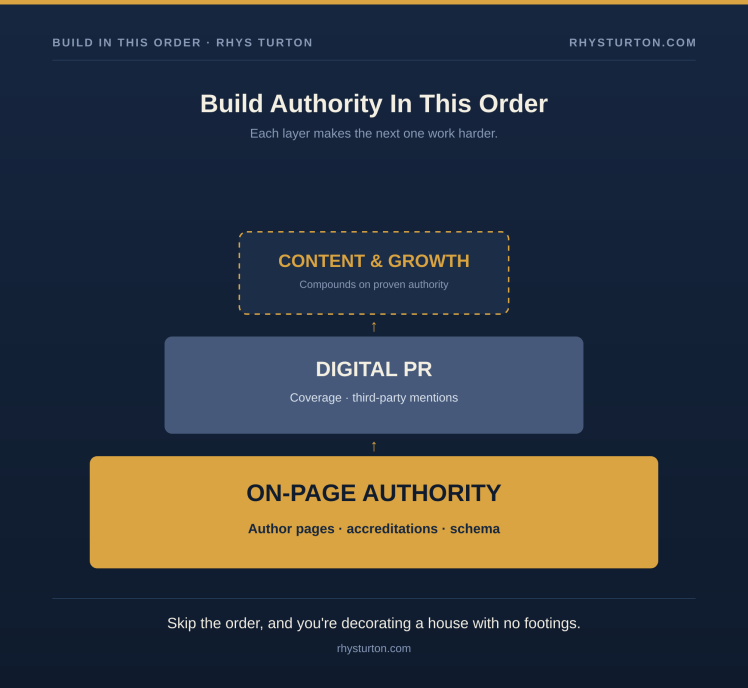
The order matters here.
Get the on-page authority signals sorted first. The case study above shows how much is available without spending a penny on anything new.
Then build on top of it with digital PR and fresh content once that foundation is actually in place.
Skip straight to PR and new content without doing the foundational work, and you’re decorating a house with no footings.
I suspect this gap only gets wider as AI search keeps growing, not narrower. Worth getting ahead of it now rather than catching up to it next year.
References Used:
https://www.averi.ai/learn/the-definitive-guide-to-geo-get-cited-by-ai-in-2026
https://ahrefs.com/blog/ai-overview-brand-correlation/
https://sunilpratapsingh.com/guides/geo/what-research-says-about-generative-engine-optimization

