There’s a pattern I keep seeing in marketing teams.
Someone goes to a Framer demo. The animations are smooth, the setup looks fast, and the sales pitch is basically “your developers can’t do this as quickly.” They’re right. It does look great. And it does build fast.
Then six months later, the site is stalling in search. Leads aren’t converting at the rate they should be. And when someone actually digs into why, the answer is the same almost every time: the platform is working against you.
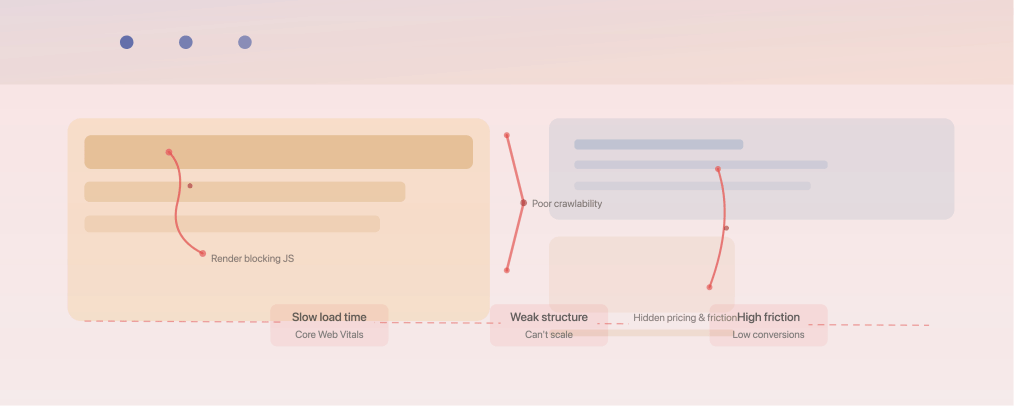
The SEO problem isn’t one thing
Framer, Webflow, and tools like them aren’t technically bad at SEO. They support meta tags. You can add structured data. You can technically do most of what you’d want to do.
But here’s the issue: they’re built around design-first thinking, and that creates a series of small inefficiencies that compound.
Render-blocking JavaScript from animation frameworks slows load times. Component-based page builders generate HTML that’s harder for crawlers to interpret cleanly. Internal linking and template control are often limited, so as your site grows, you’re fighting the platform to keep things consistent. None of these is a dealbreaker on its own. SEO rarely breaks for one big reason. It breaks because fifteen small things are working against you simultaneously.
Established platforms like WordPress are more predictable. You can inspect the output, control the templates, and scale content without hitting walls. That predictability compounds in your favour over time, the same way the small inefficiencies compound against you.
The conversion problem is worse
This one bothers me more than the SEO stuff.
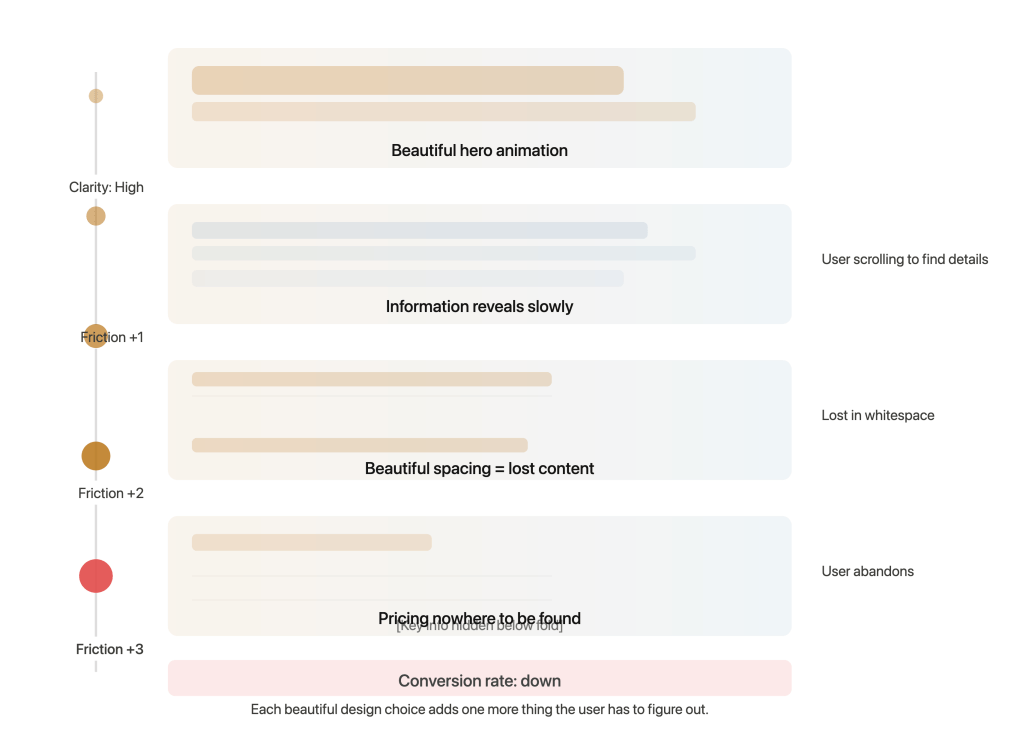
Fancy website builders encourage you to think about pages as design artefacts. Beautiful scroll interactions. Information revealed gradually. Layouts built for “experience.” The problem is that users visiting a commercial website are not there for the experience. They’re there to answer a question, compare something, or decide whether to get in touch.
When information is buried in a scroll interaction, or spaced for aesthetics rather than clarity, it adds cognitive load to what should be a simple decision. Pricing hidden two scrolls down. Key product information split across visual sections that look great in a mockup and slow people down in reality.
Conversion is about reducing friction, not adding polish. WordPress and similar platforms evolved around structured content and flexible layouts that you can actually shape around user intent. That’s not an accident.
So what’s the right call?
My position is simple: for any commercial website where you’re trying to drive leads or rank in search, build on an established CMS. WordPress is the obvious choice for most businesses. It’s mature, it’s flexible, the SEO ecosystem around it is excellent, and the developer talent pool is large.
The counterargument is usually, “but we don’t have the development resource to customise WordPress.” And a few years ago, that was a fair point.
It’s less fair now.
AI coding tools have changed what’s achievable without a dedicated dev team. I’ve used Claude to build custom WordPress templates, add animated components, and spin up new content architecture, things that would have taken a developer a sprint now take me an afternoon. Literally, a new custom post type with its own template and styling: about five minutes.
You don’t have to choose between “modern and flexible” or “stable and boring.” You can have both. You just need to put the AI assistance at the development layer, not at the platform selection layer.
The one exception
Framer and Webflow aren’t useless. They’re well-suited to specific things: rapid prototypes, short-term campaign pages, portfolio sites, or anything where long-term SEO performance and conversion optimisation aren’t the goal.
But if your website is a core commercial asset; if you’re relying on it to rank, convert, and grow over time, then the platform foundation matters more than how slick the editor looks.
Fancy website builders are optimised for the day you launch. Established CMS platforms are optimised for day three hundred.
That difference is worth paying attention to.
 Rhys Turton