“One ranking page can carry others to the top.”
That’s the theory behind the SEO colonies strategy, a technique I first came across via Edward Sturm. The idea: a page that’s already ranking and getting satisfied clicks generates its own authority. Link that page to a weaker one targeting an easier keyword, and some of that authority passes across. Once the new page ranks, you move the link again. Rinse and repeat.
It’s a genuinely clever bit of internal linking logic. So I tested it.
The setup
I run two camera comparison websites on the side. Camera comparisons are a properly competitive niche; plenty of well-established sites with real budgets fighting over the same keywords. Not client work, not anything tied to my day job, just my own patch to experiment on.
Site A got the full colonies treatment. Six target pages, linked and re-linked from the site’s strongest ranking page as each one gained ground.
Site B got whatever I judged was the best use of my time that month. Mostly a technical audit, some fixes off the back of it, and normal internal linking based on relevance rather than a rotation system.
Same six-page ambition on both sites. Same time budget: I capped myself at 12 hours cumulative per site over the full six months, and made sure Site A never got more hours than Site B. I wanted to know which approach earned more per hour, not which one won with unlimited time.
What happened, month by month
Month 1: Site B (the “just do what’s sensible” site) was ahead. The technical fixes paid off fast.
Month 3: Still ahead. The colonies approach was working, but slowly; each page needed 4 to 6 weeks of ranking stability before I could safely move the link on to the next target.
Month 4: Equal. Site A had caught up.
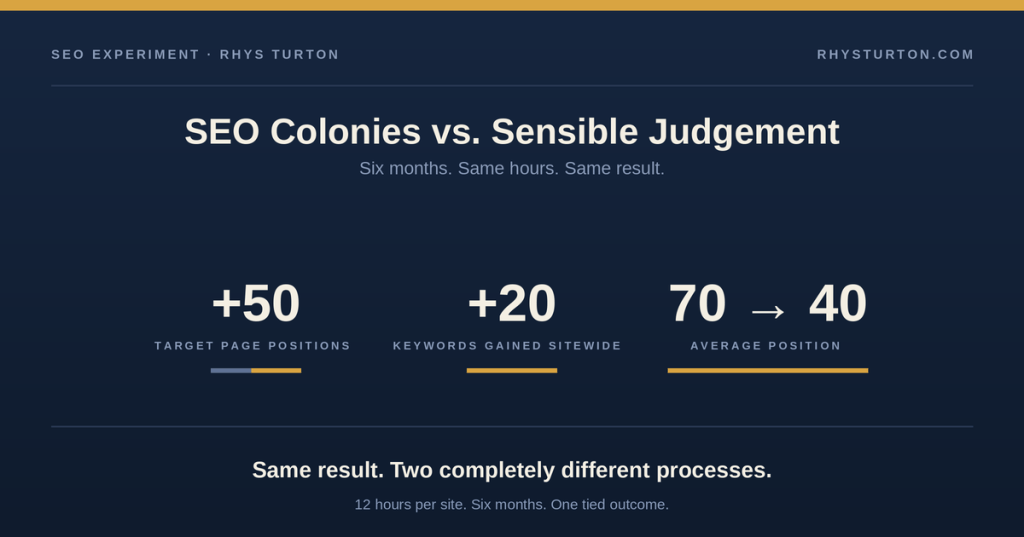
Month 6: Still equal. And here’s the number that mattered most: both sites gained the same 20 additional keywords ranking sitewide, with average position improving from 70 to 40. The six target pages on each site rose by roughly 50 positions, landing in the top 3.
Same result. Two different processes. Twelve hours each.
So does it work?
Yes. It’s not a myth, and it’s not smoke and mirrors. Authority genuinely moved from strong pages to weak ones and new keywords started ranking because of it.
But it’s not a smoking gun either. Given the same hours, doing what I judged best each month got there just as fast, and was ahead for the first three months of the test.
The real finding isn’t in the strategy. It’s in the maths. I only spent 12 hours per site over six months, deliberately keeping it low to make the comparison fair. With double that, I’d expect the “sensible judgement” approach to pull well ahead of colonies, because it isn’t gated by 4 to 6 week ranking stability cycles the way colonies is.
Where colonies actually earns its place
There’s one situation where I’d reach for this deliberately: agency-side, on a client with genuinely limited monthly hours. If you’ve only got two or three hours a month for a site, colonies gives you a repeatable, low-thinking system. Move the link, wait, move it again. No fresh strategic decision needed each visit.
For anyone with more than a handful of hours a month, though, I’d put that time into authority-building work and new content before I’d spend it threading link equity between six pages on a rotation.
The takeaway
Good technique. Slow burn. Works exactly as described. Just not better than good judgement, and definitely not a replacement for building real authority when you’ve got the hours to spend.
I’d love to hear if anyone else has tested this and landed somewhere different. If you’ve tried it, or seen someone else write it up, send it my way; I’ll happily read it and update my thinking.

