A short video has been doing the rounds that says you should build a second website. Not one tied to your brand. A “resource for your industry” with no visible link to you, which then recommends you as the solution.
The pitch is that a third-party site carries more weight with readers and with LLMs than your own site does. The first half of that is true. The second half is where it falls apart.
Why the idea is so tempting
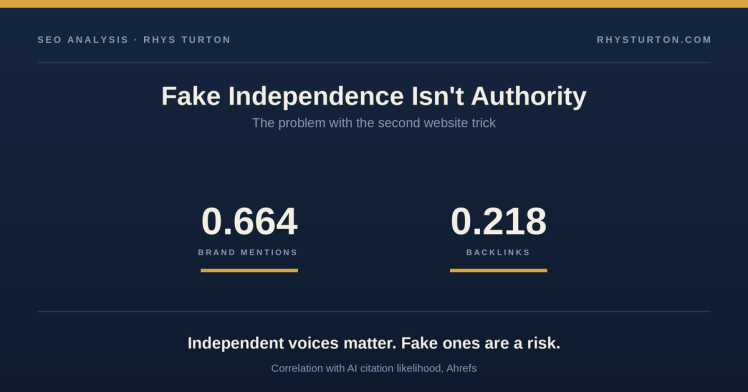
Authority has shifted from links to mentions. Ahrefs found that <a href=””>brand mentions correlate at 0.664 with AI citation likelihood, against 0.218 for backlinks</a>. Independent voices saying your name matter more than ever.
So the logic follows. If independent mentions are the prize, why not manufacture the independent voice?
I haven’t tested this, and I won’t
I’m not going to pretend I’ve run this. I haven’t, and I don’t plan to. The video offers no numbers either, so there’s nothing to check the claims against. This post is an argument, not a result.
The problem is the hiding, not the second site
Owning two websites is fine. Plenty of brands do it openly.
The trick only works if readers believe the site is independent. So the value being sold is the deception itself. Take away the secrecy and the “extra weight” goes with it.
That’s also where the risk sits.
On the Google side, there’s no policy against a second site. But the spam policies define link spam as creating links to or from a site primarily to manipulate rankings, and doorway abuse includes multiple websites built to maximise reach for a specific query. A hidden site that exists to rank and funnel people towards you sits uncomfortably close to both.
On the legal side, I’m not a lawyer, and how it applies depends on who reads the site and how it’s set up. But UK consumer law lists using editorial content to promote a product where the trader has paid for the promotion without making that clear as a banned practice. Trading standards guidance also covers failing to make it clear that someone is a trader. I wouldn’t want to be the one explaining a “neutral” site to either.
And these things rarely stay hidden. Domain records, shared analytics, writing style, the way every article lands on the same product. Someone connects the dots eventually. And then you haven’t built authority, you’ve built a story about your brand that you didn’t choose.
What a legitimate version looks like
I do think a second site can work. Just not in secret.
No hidden ownership.
No articles that exist only to point at your product.
No pretending competitors don’t exist.
Here’s what I’d actually do:
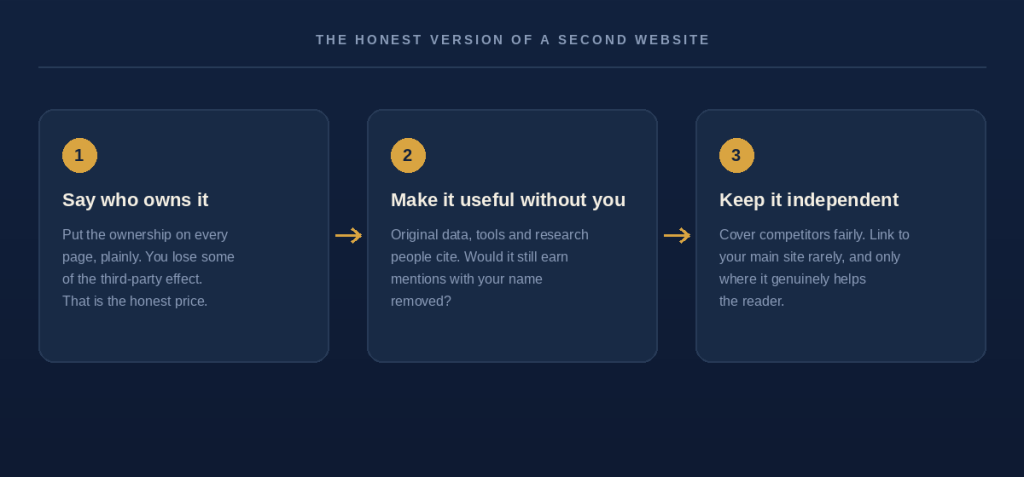
- Say who owns it. Put it on every page, plainly. You lose some of the “third-party” effect. That’s the honest price.
- Make it useful without your brand. Original data, tools, glossaries, research people cite. The test: would it still earn links and mentions if your name was removed?
- Let it be editorially independent. Cover competitors fairly. Publish things that don’t sell you.
- Keep links to your main site rare and relevant. If it only exists to pass people along, it’s a doorway.
- Judge it on its own merit. If it can’t stand alone, it’s not a resource.
A personal site is the obvious open example. Everyone knows who owns it, and it still builds authority because the expertise on it is real.
The authority that holds up
I’ve seen the honest route work. Real author pages and fixed schema moved organic traffic without new backlinks; I covered that in Authority Is a Must For SEO in the AI Era. Read that next.
Authority you have to hide the source of isn’t authority. It’s just risk with a domain name.
References
- Google Search Central, Spam policies for Google web search
- UK Government, Digital Markets, Competition and Consumers Act 2024, Schedule 20
- Ahrefs, brand mentions and AI citation study
- The video this post responds to

