In 1982, criminologists Wilson and Kelling proposed that disorder spreads. One broken window left unrepaired signals that nobody’s watching. So more windows get broken. Then graffiti. Then crime. The theory’s had its critics over the years, but the core idea has stuck around for a reason: small, visible signs of neglect change how people behave in a space.
I think the same thing happens on B2B websites. And I don’t think it’s a stretch.
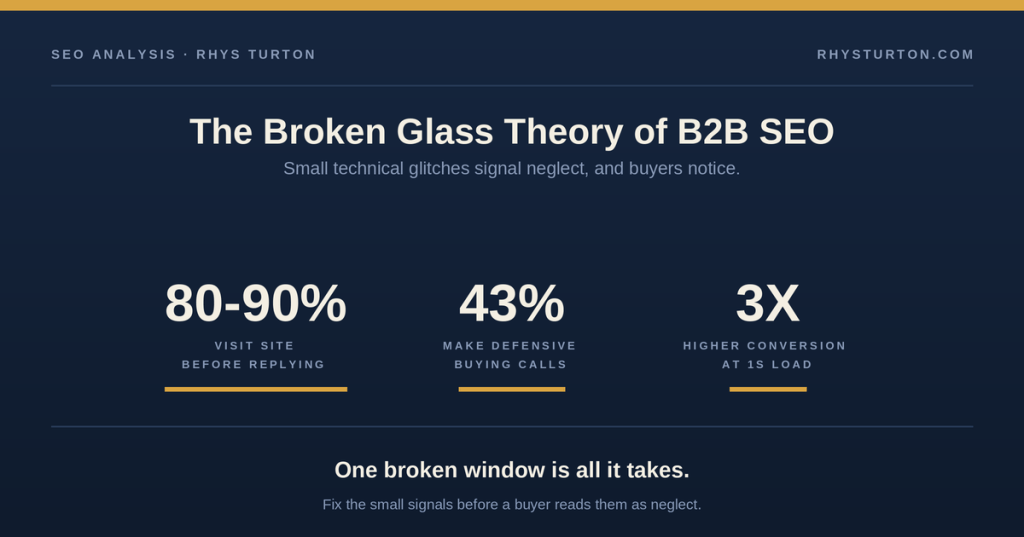
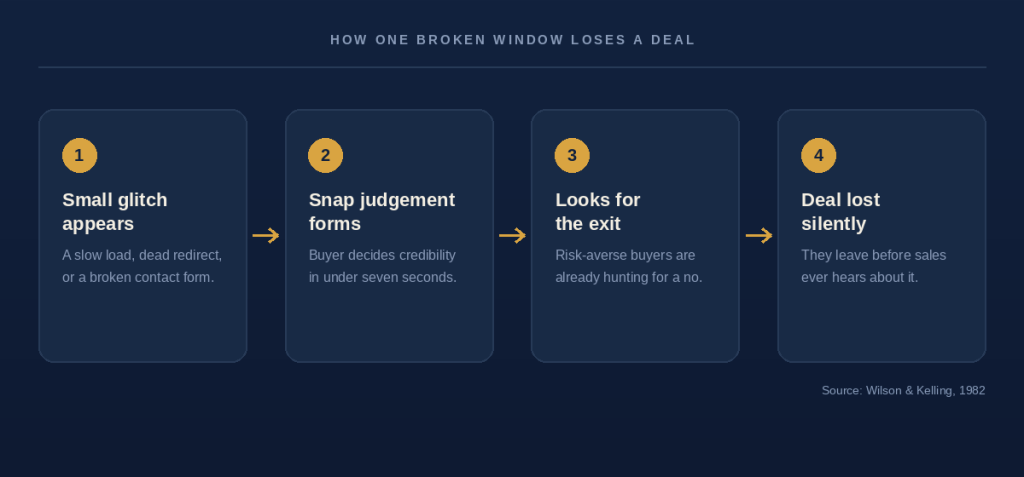
Most B2B buyers never speak to a salesperson before forming an opinion of you. Between 80% and 90% of B2B buyers visit a vendor’s website before replying to an email or LinkedIn message, and that visit produces a snap judgement inside the first seven seconds. A slow load, a broken form, a page that jumps around while it’s rendering; these are named, specifically, as some of the fastest ways to fail that judgement. Nobody’s reading your case studies yet. They’re just deciding whether you’re worth the time.
Here’s why that snap judgement matters more in B2B than it does anywhere else. Forrester’s research found that 43% of B2B buyers make defensive purchase decisions more than 70% of the time, meaning most buyers are actively looking for reasons to say no, because a bad vendor choice reflects on them personally, in front of colleagues, on a budget line someone will ask about later. A broken window doesn’t just cost you a bounce. It hands a risk-averse buyer exactly the reason they were already looking for.
And buyers don’t compartmentalise a glitchy website from a glitchy product. If your redirect chains are a mess and your contact form times out, the obvious question is “if they can’t get this right, what does that say about the software?” Load speed makes the same point with harder numbers: B2B websites that load in one second convert at three times the rate of sites taking five seconds, and five times the rate of sites taking ten, per research from Tenet. That’s not impatience. That’s buyers making a competence judgement before they’ve read a word of your copy.
This is why I’ve never understood the argument that SEO health scores are a vanity metric. A health score isn’t just a technical checklist; it’s a proxy for exactly the kind of neglect Wilson and Kelling were describing. Broken redirects. Orphaned pages. Slow templates nobody’s touched in years. Each one is a small window. Leave enough of them unrepaired and a risk-averse buying committee starts assuming the whole building is unsound.
The fix isn’t complicated. It’s just unglamorous. Go and find your broken windows before a prospect, or their procurement team, does.
If you’re mid-migration or about to be, a pretty redesign won’t save you from this. And if you want the wider case for why this stuff compounds in the AI search era, I’ve made that argument here too. Otherwise, have a browse through my case studies for what fixing this actually looks like for B2B sites.
References
- Wilson, J.Q. and Kelling, G.L. (1982) “Broken Windows: The police and neighborhood safety,” The Atlantic.
- LowCode Agency, “What B2B Buyers Check on Your Site Before Replying” (lowcode.agency) — 80-90% of B2B buyers visit a vendor’s website before replying to outreach; credibility judgement formed within the first seven seconds.
- Forrester, “Are B2B Buyers Cowards? The Importance of Trust,” Business Trust Survey, 2023 (forrester.com) — 43% of B2B buyers make defensive purchase decisions more than 70% of the time.
- Tenet, “Website Speed and Page Load Time Statistics” (wearetenet.com), citing Portent’s original site speed study — B2B websites loading in one second convert at three times the rate of five-second sites, and five times the rate of ten-second sites.

